We're Open Every Saturday


You spend roughly a third of your life lying down. That’s not a trivial amount of time, and it means that however your body is positioned during those hours has a cumulative effect on your spine, joints, and muscles that shows up whether you notice it or not. For a lot of people, the back pain they feel in the morning isn’t from something they did during the day — it’s from what happened while they were asleep.
Sleep posture is one of the most overlooked contributors to chronic back and neck pain, and it’s one of the most correctable. The changes required aren’t dramatic. But they do require understanding what’s actually happening to your spine while you sleep, and why certain positions create problems that others don’t.
How Sleep Position Affects Spinal Alignment
The Spine Doesn’t Take a Night Off
Your spine has natural curves — a gentle inward curve at the cervical spine (neck), a slight outward curve at the thoracic spine (mid-back), and an inward curve again at the lumbar spine (low back). These curves distribute load efficiently and allow your discs, joints, and muscles to function without excessive strain during movement.
The problem with sleep posture is that it can hold your spine in positions that distort these natural curves for hours at a stretch. Unlike sitting at a desk, where you might shift positions every few minutes, sleep posture is sustained. The same mechanical stress applied to the same tissues for six to eight hours, night after night, accumulates into patterns of dysfunction that eventually produce pain.
For patients across Beverly Hills dealing with persistent morning stiffness or back pain that doesn’t have an obvious cause, a chiropractor in Beverly Hills, CA, at The Chiro Guy™ regularly identifies sleep posture as a contributing factor in cases that haven’t responded to other interventions because it’s so often the piece that gets overlooked.
The Three Sleep Positions and What Each Does to Your Spine
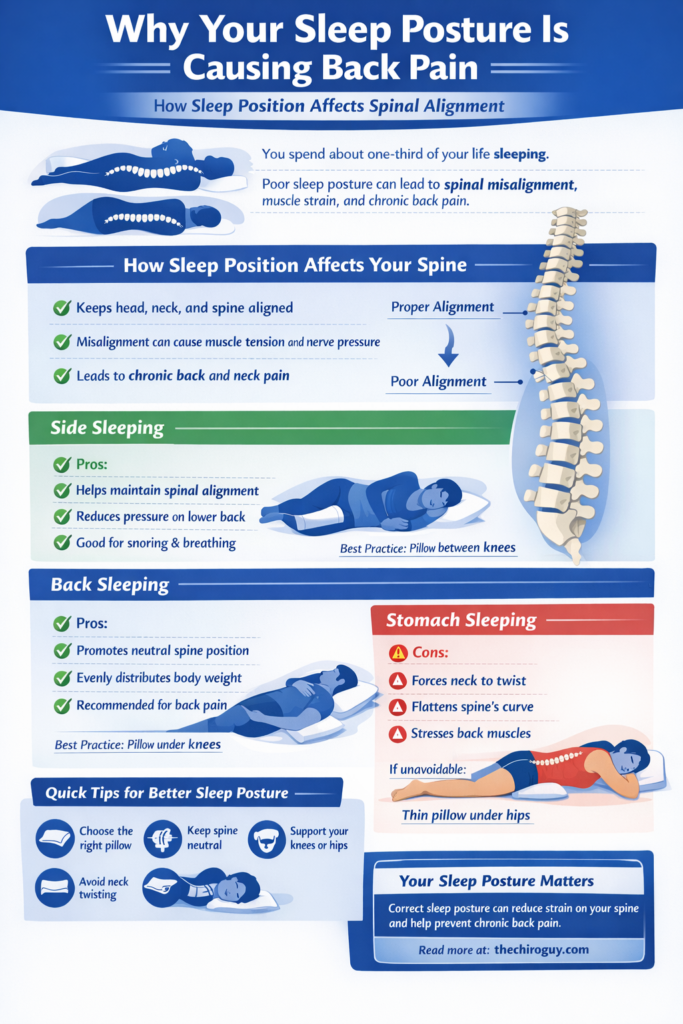
Side Sleeping: The Most Common, Done Right or Wrong
Side sleeping is the most widely recommended position for spinal health, but only when done with proper support. The key issue for side sleepers is lateral spinal alignment. When you lie on your side without adequate support between your knees, your top leg falls forward, rotating the pelvis and creating a twisting force on the lumbar spine that persists through the night.
A firm pillow between the knees corrects this by keeping the hips stacked and the pelvis in a neutral position. The head pillow also matters significantly. It should fill the gap between your ear and the mattress, keeping your cervical spine horizontal rather than angled upward or downward. A pillow that’s too flat or too thick creates problems; one forces lateral flexion toward the mattress, the other pushes the head into the opposite direction.
Back Sleeping: Good in Theory, Complicated in Practice
Sleeping on your back can support your natural spinal curvature well, provided the mattress offers adequate support and a pillow isn’t pushing your head too far forward. The common failure mode for back sleepers is a pillow that’s too thick, which places the cervical spine in forward flexion throughout the night and strains the posterior neck muscles and cervical facet joints.
Placing a pillow or rolled towel under the knees while sleeping on the back reduces tension on the lumbar spine by slightly flexing the hips and decreasing the extension force on the lower back. For people with lumbar disc issues or facet joint irritation, this adjustment alone can make a significant difference in morning symptoms.
Stomach Sleeping: Hardest on the Spine
Stomach sleeping is the position most consistently associated with neck and back problems, and the mechanics explain why clearly. To breathe while lying face-down, your head must be rotated to one side — maintaining a sustained cervical rotation for hours that strains the facet joints, compresses the intervertebral foramina on one side, and creates uneven tension across the posterior neck musculature.
The lumbar spine is also affected. With the abdomen on the mattress and nothing supporting it, the lower back falls into extension, compressing the posterior elements of the lumbar vertebrae. Over time, this pattern contributes to facet joint irritation and can aggravate existing disc problems. Transitioning out of stomach sleeping isn’t easy for habitual stomach sleepers, but it’s one of the more impactful changes a person can make for their spinal health.
What The Chiro Guy™ Looks for in Evaluating Sleep-Related Pain
Connecting Your Symptoms to the Pattern
Morning back pain that eases within an hour or two of being upright is a specific clinical pattern. It suggests that the tissues involved are mechanically loaded during rest rather than during activity, pointing directly to sleep posture, mattress quality, or pillow support as contributing factors.
During a chiropractic evaluation, the assessment goes beyond the location of your pain. The pattern of restriction matters, which directions of movement are limited, whether stiffness is symmetric or asymmetric, and whether certain spinal segments are consistently hypomobile or irritated. These findings, combined with a history of when and how symptoms appear, help determine whether sleep posture is a primary driver or a contributing factor alongside other mechanical issues.
Vertebral subluxations (areas of the spine with reduced joint mobility and altered biomechanics) often develop over time from sustained postural stress, including sleep posture. Chiropractic adjustments restore normal joint mobility in these segments, thereby reducing the mechanical irritation that drives morning pain. But without also addressing the posture that created the problem, the results are temporary. That’s why The Chiro Guy™ combines hands-on treatment with practical guidance on sleep positioning, pillow selection, and mattress assessment.
Practical Changes That Make a Real Difference
What You Can Adjust Starting Tonight
Small, consistent modifications produce results over time. Here’s what The Chiro Guy™ consistently recommends to patients dealing with sleep-related back and neck pain:
- Side sleepers: Use a firm pillow between your knees and ensure your head pillow keeps your cervical spine horizontal. A body pillow can help maintain position through the night.
- Back sleepers: Choose a cervical pillow contoured to support the natural neck curve, and place a pillow under your knees to reduce lumbar extension.
- Stomach sleepers: Begin transitioning to side sleeping by using a body pillow in front of you to prevent rolling onto your stomach. Change takes weeks; consistency matters.
- Mattress assessment: A mattress that’s too soft allows the heaviest parts of the body — hips and shoulders — to sink, creating lateral spinal curves in side sleepers and excessive lumbar extension in back sleepers. Medium-firm mattresses are generally supported by the research for spinal health.
- Pillow replacement schedule: Most pillows lose their support capacity within one to two years. A flattened or lumpy pillow is a direct contributor to cervical spine stress.
Patients throughout Beverly Hills and the greater Los Angeles area who spend significant time at desks, in cars, or managing physically demanding work often find that sleep posture is the cumulative stressor that tips the balance, converting manageable daytime tension into consistent morning pain.
Stop Starting Your Day in Pain
Morning back pain isn’t something you have to accept as normal. The Chiro Guy™ works with patients throughout Beverly Hills and the surrounding communities to identify the mechanical patterns driving their symptoms, including those that occur during sleep. Call today or book your evaluation online to find out what’s actually behind your back pain and what a practical recovery plan looks like for your specific situation.
People Also Ask
Can a bad mattress cause chronic back pain?
Yes. A mattress that lacks adequate support allows the spine to rest in misaligned positions for hours nightly. Over time, this creates persistent mechanical stress on discs, joints, and muscles. Medium-firm mattresses are generally recommended for most sleepers with back pain.
How long does it take to adjust to a new sleep position?
Most people need two to four weeks to feel comfortable in a new sleep position. Using physical supports, such as body pillows, to prevent reverting helps significantly. Discomfort during the transition is normal and typically decreases with consistency.
Can chiropractic care fix sleep-related back pain?
Chiropractic adjustments restore joint mobility in spinal segments affected by sustained postural stress, relieving mechanical pain. Combined with posture correction guidance, the results are more durable than treatment alone — addressing both the symptom and the contributing habit.
Is it normal to wake up stiff every morning?
Mild stiffness that resolves quickly is common, but significant morning stiffness lasting more than an hour warrants evaluation. It may indicate inflammatory conditions like ankylosing spondylitis or mechanical issues related to sleep posture and mattress support.
Does pillow height really affect neck pain?
Yes, substantially. A pillow that’s too high or too low holds the cervical spine in lateral flexion or extension for hours. The ideal pillow keeps your head in a neutral position, neither angled toward the ceiling nor dropped toward the mattress, regardless of sleep position.